

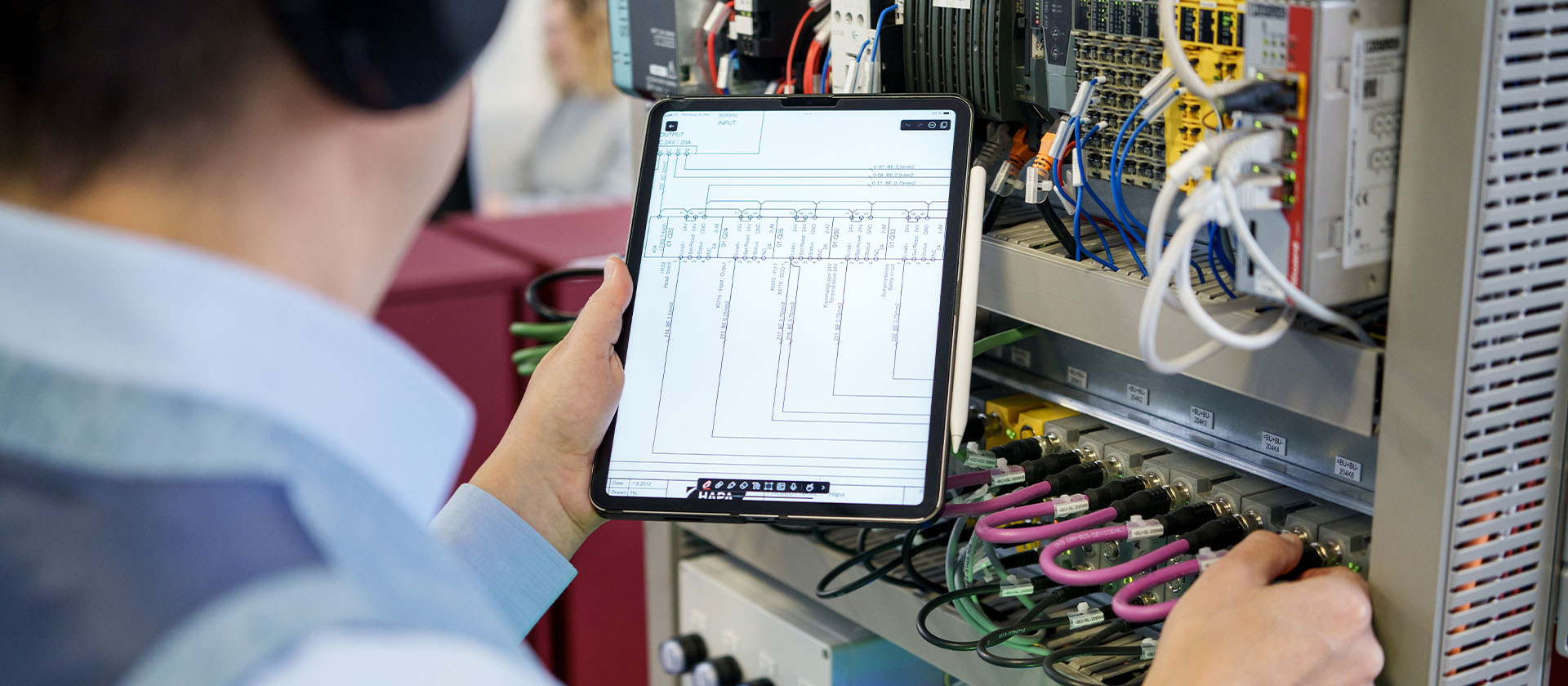
What innovation means at Hapa
Innovation is often associated with breakthrough technologies. In reality, it is just as often shaped in smaller moments, in discussions, in testing, and in improving details that make a difference in daily operations.
At Hapa, a provider of inline printing solutions for pharmaceutical packaging, innovation happens across both dimensions: from continuous improvements in existing systems to the development of entirely new machines and technologies.
In this interview, Development Engineers Samuel Jenni and Joseph Bejjani share how ideas take shape in practice, and how they become solutions that meet real customer requirements.
Where innovation begins
Innovation at Hapa starts within a structured development environment, shaped by clear objectives, while always staying closely connected to real-world requirements.
“Our work is usually project-based,” Samuel explains, “but there’s always something happening in parallel, something unplanned you need to react to in a flexible way.”
Joseph adds: “You might be working on a new development, and at the same time something comes in from the field that needs to be solved immediately.”
Looking at things differently
For both Engineers, innovation is less about radical invention and more about perspective.
“Innovation isn’t always about creating something completely new,” Joseph says. “Very often, it’s about rethinking what we already have, improving it, or applying it somewhere else.”
“For me, it begins with asking why,” Samuel adds. “Why do we do it this way? Could we approach it differently?”
“Some ideas might sound unusual at first,” he continues, “but once you talk about them, they can evolve.”
At the same time, this way of thinking also feeds into larger developments, including new machine concepts.
Turning ideas into solutions
Creativity alone is not enough. Structure is equally important. “We start by identifying the biggest pain point,” Joseph explains. “Then we explore solutions, test them, and let the data guide our decisions.”
This ensures ideas work not just in theory, but in real production environments, where requirements are constantly shaped by actual use cases.
“You really want the solution to work,” Samuel says. “That pushes you to try different options, even if you're not sure at first.”
Better solutions through exchange
No idea is developed alone. Collaboration is part of everyday work. “I often just share ideas with colleagues and see what they think,” Samuel says.
Joseph highlights the value of feedback: “Different perspectives, especially from experienced colleagues, help improve what you’re working on.” “We often just talk things through,” he adds. “Sometimes it’s quick, sometimes it turns into deeper problem solving.”
“I’ve never felt discouraged from asking why something is done a certain way,” Samuel says. “Usually, it leads to a better understanding.”
The impact of small details
Not all innovation is visible at first glance. “We look closely at how Operators interact with the machine,” Joseph says. “Is it intuitive? Is it easy to use?”
“If something is inconvenient, that’s what people remember,” Samuel explains. “Even if everything else works perfectly.”
This mindset leads to continuous improvements, from simplifying maintenance steps to reducing consumables. Small changes, but with a big impact. At the same time, they build on a strong technological foundation and contribute to larger innovations.
When effort turns into results
“When something works as expected, that’s a great feeling,” Samuel says. “When a machine we worked on is installed on customer site, it shows we solved a real problem.”
That connection to real needs is reflected directly in development work. “If I receive inputs, I can often adapt them directly in my work,” Samuel adds.
For Joseph, collaboration stands out most: “We were working under pressure on something new. What stood out was how many people, internally and externally, contributed to making it work.”
Looking ahead
At Hapa, innovation is a continuous process – combining curiosity, collaboration, and experience to improve technologies and how they are used in real production environments.
Sometimes, it starts with a simple conversation.
Curious to exchange ideas or explore new possibilities? The Hapa team is always open to continuing the conversation.